


Payment method

New delivery

BLOG
Reference: 0001
Brand: Baofeng
Reference: 1020000000212
Brand: Nagoya
Reference: 1010000000027
Brand: Baofeng
Reference: 1070000000841
Brand: Satec
Reference: 1070000000807
Brand: Satec


High power and a clean transmit signal providing a big edge in contests and DXing.
A new, innovative transceiver style.
In today's world of communication, the IC-7760 introduces a new system consisting of a remote control head and an RF deck, connected together with a commercially available control cable (LAN). This concept increases the flexibility of the station setup, freeing up more desk space by placing the RF deck closer to the antenna feed point. In addition to the direct connection between the control head and the RF deck, take advantage of your home network so any desktop can be used, since no computer is required!
The controller, in the form referred to by the manufacturer as \control head\" together with a separate radio called the RF deck, is designed to save desk space and to be placed as close to the antenna as possible.
The IC-7760 consists of a separate remote control head and RF unit, using a LAN cable; a control cable (3 m, 9.8 ft) is supplied with the transceiver, and a commercially available LAN cable* can be used to install the RF deck in a more remote location. This allows the transceiver to be placed in a cabinet or other location away from the operating desk, providing a quiet environment away from the fan noise used to dissipate the heat generated by the RF circuitry.
* LAN cable: Cat5e or higher. Cable length: Maximum 100 m, 328 ft
Flexible remote operation at homeSupports remote control at home via a home LAN network connection. Thanks to the simple setup, which requires no computer, the 7760 controller can be carried anywhere in the house and operated not only from your QTH, but also from outside, as long as a LAN connection is available. |
|
Dual, independent receiversThe IC-7760 has independent MAIN/SUB receivers - complete circuits from the antenna to the speaker - so that one receiver section does not affect the other. The dual circuits provide simultaneous reception of two signals on different bands/modes with identical quality. As with the IC-7851, dual spectrum scopes provide simultaneous display of the MAIN and SUB bands, allowing the operator to see changing band conditions. |
 Receiver block diagram |
The IC-7760 uses a direct RF sampling system in which RF signals are converted directly into digital signals, which are then processed by an FPGA (Field Programmable Gate Array). This system avoids the nonlinear distortion that occurs at the mixer stages during analog signal processing. In addition, by employing DSP units in both the RF deck and the control head, the IC-7760 is able to handle complex audio path switching due to the various interface inputs and outputs, while minimizing latency in a home LAN network environment.
 |
Block diagram overview
|
DIGI-SEL (digital preselector) is highly effective at rejecting strong out-of-band signals, such as those from broadcast stations or multi-multi operations.
In conventional models (such as the IC-7850/51 or IC-7610), the DIGI-SEL circuit was located shortly after the RF input (antenna) to prevent signal distortion from out-of-band interference.
Even when the preamp was turned on, the noise figure (receiver sensitivity) could not be improved, because DIGI-SEL had insertion loss due to its narrow bandwidth.
In the IC-7760, which is a direct sampling system, DIGI-SEL prevents overflow (OVF) caused by unwanted out-of-band signals, rather than signal distortion, and the preamp makes full use of the A/D converter's dynamic range. When the preamp is turned on in the IC-7760, the preamp first amplifies the desired signal, and then DIGI-SEL filters out unwanted out-of-band signals. This allows the preamp to work together with DIGI-SEL.
 Block diagram overview |
DIGI-SEL and PREAMP comparison |
A total of 15 separate bandpass filters (BPF)While the previous model covered the HF bands with a 9-way separated bandpass filter (BPF), the IC-7760 uses an 11-way separated bandpass filter (BPF) on the HF bands. In addition, thanks to sharp filters specialized for each amateur band, the BPF effectively suppresses out-of-band interfering signals at the RF stage and prevents overflow in the A/D converter. |
BPF modules on the RF board |
BPF characteristics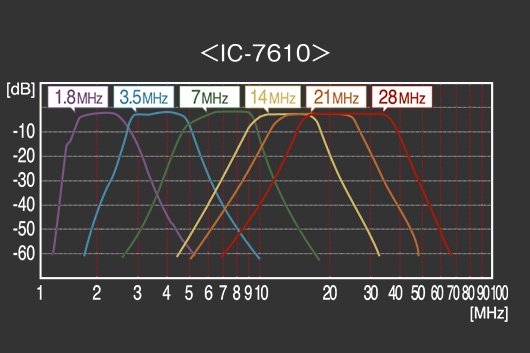 |
BPF characteristics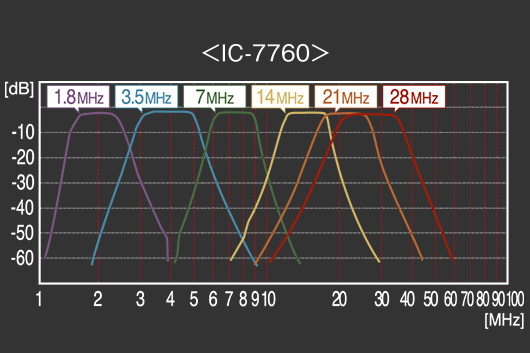 |
The DPD function corrects nonlinear distortion in the final amplifier by applying inverse distortion in advance. This achieves a clean transmit signal while providing 200 W of high output power. The DPD function also works at 1 kW output when used together with the IC-PW2* amplifier.
 DPD off |
 DPD on |
The IC-7760 uses a 450 W, 65 V class LDMOS-FET transistor in the PA section, combined with a large heatsink and an effective cooling system, to achieve 200 W of full power output*. Continuous operation in FT8 mode is also possible. In addition, modulation and frequency conversion are performed through digital signal processing, with the D/A converter directly outputting the transmit frequency, achieving the cleanest possible C/N transmission. Thanks to the use of a 450 W FET transistor at a 200 W output power, the PA achieves excellent IMD characteristics.
* 200 W and 1 hour of continuous transmission at an input voltage of 100 V AC (at an ambient temperature of 25°C.)
 Final power stage with a large heatsink |
 Effective cooling system with four fans |
Built-in automatic antenna tunerThe IC-7760 features a built-in antenna tuner with mechanical relays, the first among our 200W models. It provides faster tuning than the conventional variable-capacitor type. After tuning, the matched information is automatically recalled the next time the frequency is selected, making smooth band changes and multi-band operation easier. |
 Antenna tuner module |
Control head (controller) with dual displayThe IC-7760 controller has two displays, a main and a sub display. These are a 7-inch main display (800 x 480 pixels, WVGA) and a 2.4-inch diagonal sub display (320 x 240 pixels), and both displays are touchscreens. The main display shows the information needed for operation, including the MAIN/SUB operating frequencies, the settings/operating status of each function, as well as the spectrum scope, S-meter, and RTTY/PSK31/63 decode messages. |
 Meter setting example |
The 2.4-inch sub display can show filter settings, various meters, and a band-stacking register. The filter setting screen can display the IF filter passband width and the IF filter shape overlaid on the IF filter passband signal. This function shows visible images of the twin PBT and manual notch effects. Better visibility of information increases functionality and provides smoother operation.
 |
 |
 |
Dual spectrum scope and waterfall display modeThe dual spectrum scope delivers excellent sweep speed, resolution, and a wide 100 dB dynamic range, with combined FPGA, DSP, and CPU processing for the main and sub bands. It can also monitor two different bands simultaneously, which is useful for monitoring band conditions and during contests. The dual scopes can be displayed side-by-side or top-to-bottom, depending on the situation and your needs. In Continuous SCROLL mode, a wide band spanning over 1 MHz can be viewed on the scope screen. The waterfall display shows changes in the frequency spectrum vertically, allowing the user to find a weak signal that is hard to detect using the spectrum scope alone. It increases QSO opportunities without missing weak DX stations. |
 |
 |
 |
The Audio Scope screen shows the frequency components of the transmitted and received signal in FFT display, as well as its waveform components on the scope. The Audio Scope makes it easy to monitor signal characteristics such as the mic compressor level, filter width, and notch filter. You can monitor received CW keying waveforms on the oscilloscope.
|
|
 |
| FFT with waterfall display | Oscilloscope |
|---|---|
| ・Scope Attenuator: 0dB, -10dB, -20dB, -30dB ・FFT waterfall spectrum display: on/off ・Waveform type: Line, fill ・Waveform color: Adjustable |
・Scope level: 0dB, -10dB, -20dB, -30dB ・Sweep time: 1ms, 3ms, 10ms, 30ms, 100ms, 300ms/Div ・Spectrum waveform color: Adjustable |
Dual speakersThe IC-7760 is also equipped with dual speakers. By separating the MAIN/SUB audio to the left and right speakers respectively, audio discrimination during Dualwatch operation has been improved. The MAIN/SUB audio can be set to stereo output or mono output from both speakers.
|
 Dual speakers |
Automatic contest serial numberingThis function is very useful in CW and RTTY contests. Each time a pre-programmed memory is transmitted, the serial number is automatically counted starting from 001. The serial number can be set in multiple places to ensure reliable copying of the contest number. |
 Contest QSO numbering example |
Introduced with the IC-7300. Since FT8 is actively used worldwide in everyday operation as well as in DX expeditions, FT8 can be easily configured simply by selecting it from the [Preset] memory, with all the necessary settings applied at once. In addition, to return to normal settings from FT8, simply select the [Normal] memory for a smooth transition. Furthermore, up to 3 [Preset] memories can be saved for SSTV presets, as well as for future new digital modes to be supported.
|
|
 Settings display example |
RC-28 as a second VFO dialBy connecting the optional RC-28 desktop controller via USB, you can conveniently operate the IC-7760's SUB band tuning at your fingertips. The MAIN/SUB switching buttons can be assigned to the F-1 and F-2 buttons on the RC-28, and it can function as the main dial for both the MAIN and SUB bands. This allows for a quick response to DXpedition stations operating split, as well as for Dualwatch. |
 RC-28 for a second VFO dial |
SD card slotAn SD card slot is provided as a data storage interface. In addition to voice recordings of outgoing and incoming calls, RTTY/PSK decode logs, captured screen images, user settings, and firmware updates can be saved to memory. Voice memories sent in phone modes and message memories sent in CW/RTTY/PSK modes can also be stored. In addition, when the operator changes, the new operator can simply load their preferred settings from memory to start operating immediately. |
 Memory card slot |
Touchscreen and multi-function dialThe combination of the touchscreen and multi-function dial provides easy access to various settings. When the multi-function dial is pressed, menu items appear on the right side of the display next to the dial. Touch this menu to select an item, then turn the multi-function dial to adjust the level, providing much faster access to various functions such as RF power, mic gain, DIGI-SEL, and notch functions. |
 |
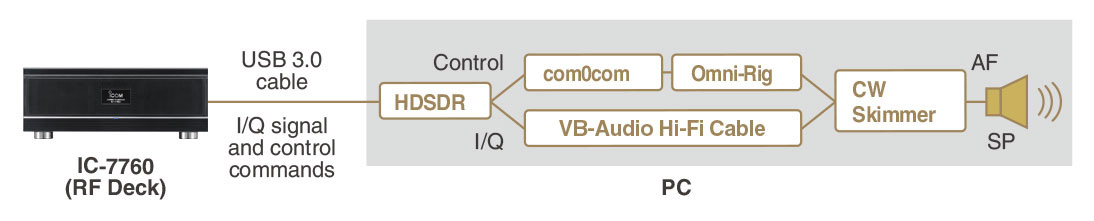
I/Q signal outputI/Q signals received by the IC-7760 can be output from a dedicated I/Q signal connector (USB on the RF deck) to a computer for digital output. Using the I/Q signals with HDSDR (free software), you can listen to received signals or display the spectrum scope on a computer. Used together with CW Skimmer* or N1MM Logger+*, you can virtually decode all Morse signals in the operating band. This function is especially useful for contests and DXing, as well as for effective callback when operating split. |
 USB socket on the RF deck (USB 3.0 cable required) |
 |
RS-BA1 - Internal serverWhether from a remote part of your home QTH or from a remote location somewhere in the world, the software RS-BA1 version 2, allows you to operate the IC-7760. The Dualwatch function and dual spectrum scopes with waterfall functions can be used on the remote computer. With the addition of an Ethernet connection, a base station computer is not required. |
 Remote control using RS-BA1 |
DVI-D connectorThe IC-7760 has a DVI-D connector on the remote control head to display the radio's screen image on an external monitor. |
 External auxiliary monitor |
RX antenna - BNC-type RX IN/OUT connectors for the receive antenna or external BPF/preamp connection
"""

Manufacturer: ICOM
ICOM INCORPORATED 1-1-32
Kami-minami
Hirano-ku
Osaka
547-0003
Japan info@icomeurope.com
e-mail: info@icomeurope.com
Osoba odpowiedzialna:
HamRadioShop
Cezary Libert
ul. Piękna 65/67/25
93-558 Łódź
Polska
e-mail: info@hamradioshop.pl
tel. +48 602 675 847

Reference: 1010000000150
Brand: AnyTone
Reference: 1010000000119
Brand: Yaesu
Reference: 1010000000125
Brand: ICOM
Reference: 1100000001270
Brand: Yaesu
Reference: 1070000001609
Brand: AnySecu
Reference: 1010000000153
Brand: AnySecu
Reference: 1010000000133
Brand: QYT
Reference: 1010000000171
Brand: Hiroyasu / Sifang
Reference: 1010000000146
Brand: ICOM
Reference: 1100000001271
Brand: Yaesu
Reference: 1010000000148
Brand: Xiegu
Reference: 1010000000163
Brand: Yaesu
Reference: 1010000000123
Brand: QYT
Reference: 1010000000126
Brand: ICOM
Reference: 1010000000147
Brand: Xiegu
Reference: 1010000000105
Brand: ICOM

Reference: 1100000001298
Brand: ICOM
Reference: 1020000001306
Brand: ICOM


